Create in Subic
- Website design
- Development
- Experience architecture
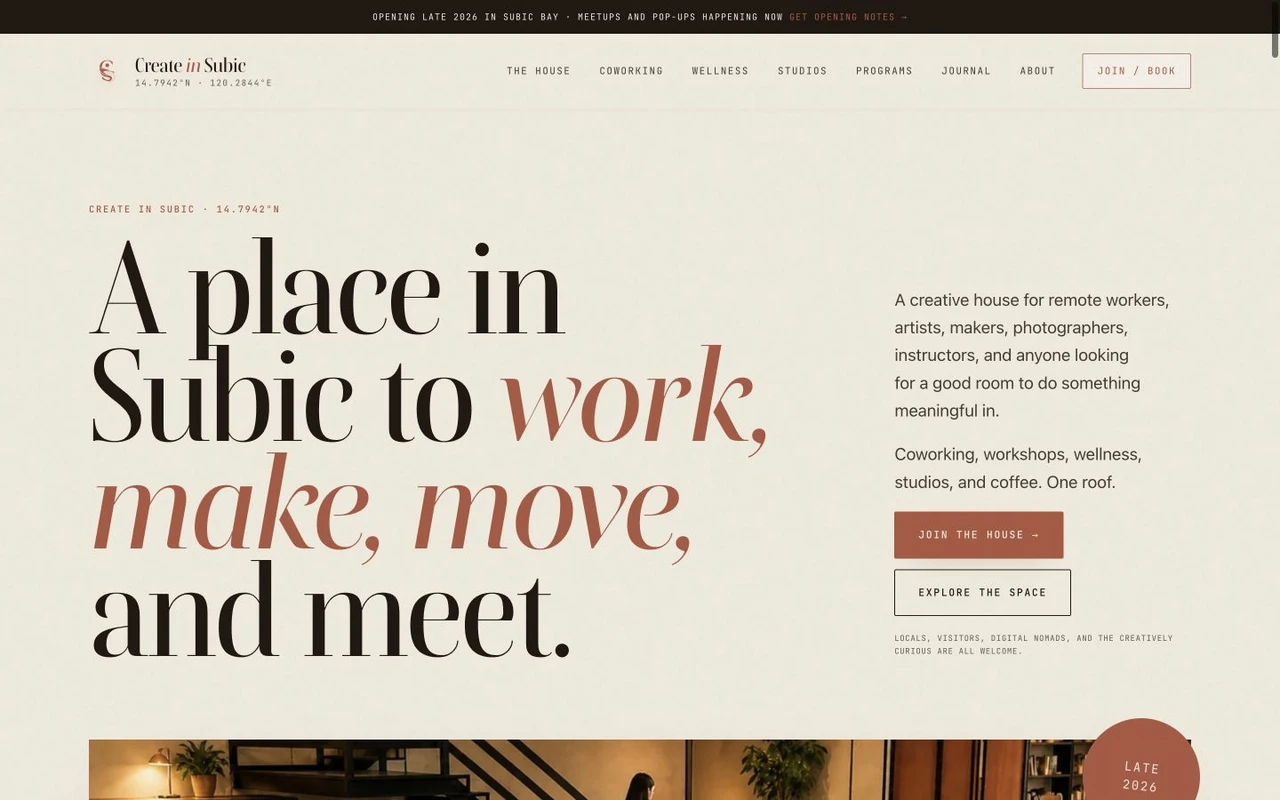
A website introducing a planned creative house in Subic Bay, with distinct routes into coworking, studios, workshops, wellness and community activity.
The brief
The house brings together several different experiences. Its website needs to make each one understandable while communicating the character of a single place.
Explore the complete design.
Move through the design, from the first impression to the final detail. Drag the page control or scroll inside a preview.

Design decisions
Organise the house around what people come to do.
The site gives working, making, moving and gathering their own entry points. Space-led imagery and practical information help visitors explore an activity and find the relevant join or enquiry route.
- Distinct routes for the different uses of the house.
- Space and activity content with a consistent identity.
- Clear invitations to join, enquire or explore a programme.
Across devices
Find your way into the house.
A clear mobile hierarchy helps visitors move from the overall idea to the space or activity that matters to them.
The thinking behind the work
Make a many-sided creative house easy to understand.
Create in Subic brings coworking, studios, workshops, wellness and community activity into one planned place. The website’s business role is to help different people recognise how they might participate, then find the relevant information and invitation without losing the character of the house.
Finding a reason to visit
Organise the offer around what people come to do.
Working, making, moving and gathering each have their own entry points. This structure reflects the different intentions someone may bring to the site: looking for a place to work, exploring a studio or finding a programme. The visitor can start with the activity that is meaningful to them.
For a business with several offers, that distinction gives each one room to be understood. The intended benefit is better orientation: people can recognise a relevant use for the house without having to interpret every part of the wider concept first. The overall introduction still connects those activities as one place.
Understanding the place
Pair the atmosphere with practical detail.
Space-led imagery and activity content give the planned house a tangible presentation. The site then brings practical information alongside the visual introduction, so interest in the atmosphere can lead to a closer look at how a particular space or activity is intended to work.
This balance matters when the place is still being introduced to its audience. The website can communicate the design and purpose of the house while retaining its planned status. The rationale is to support clear expectations, giving prospective participants enough context to decide what they want to learn more about.
Turning interest into participation
Give each audience a relevant next step.
Join, enquiry and programme routes connect the different parts of the site to an action. A visitor can follow the path associated with their interest instead of arriving at a broad introduction with no obvious continuation. The mobile hierarchy preserves these choices for people browsing on a phone.
Commercially, the purpose is to organise interest around the house’s different experiences and make conversations easier to begin. The website supports that relationship before a visit or activity takes place. It does not need to make every visitor choose the same offer to provide a coherent and useful introduction to the business.
The experience in practice
From curiosity about the house to a relevant invitation.
Find your activity
Choose the route that matches working, creating, movement or gathering.
Explore the details
Read the space or programme information and understand its intended use.
Continue the conversation
Follow the relevant join or enquiry route for that part of the house.